
 Austria
 Belgium
 Switzerland
 Germany
 Spain
Spain
 France
 United Kingdom
 Ireland
 Italy
Italy
 Netherlands
- EN
Netherlands
Netherlands
- EN
Cancelling a charity donation: how to stop donating for good
Outside the supermarket someone is waiting with a tablet and a story that is entirely sincere. It is about children, or about water, or about a forest that will be gone in ten years. You listen, you nod, and within two minutes you have signed. Four euros a month. You will never notice it.
Two years later you do notice. Not in your balance, but in the four direct debits that come round every month, from organisations of which you can still place only one. You decide to do something about it, you search the website for "cancel", and that is where it begins.
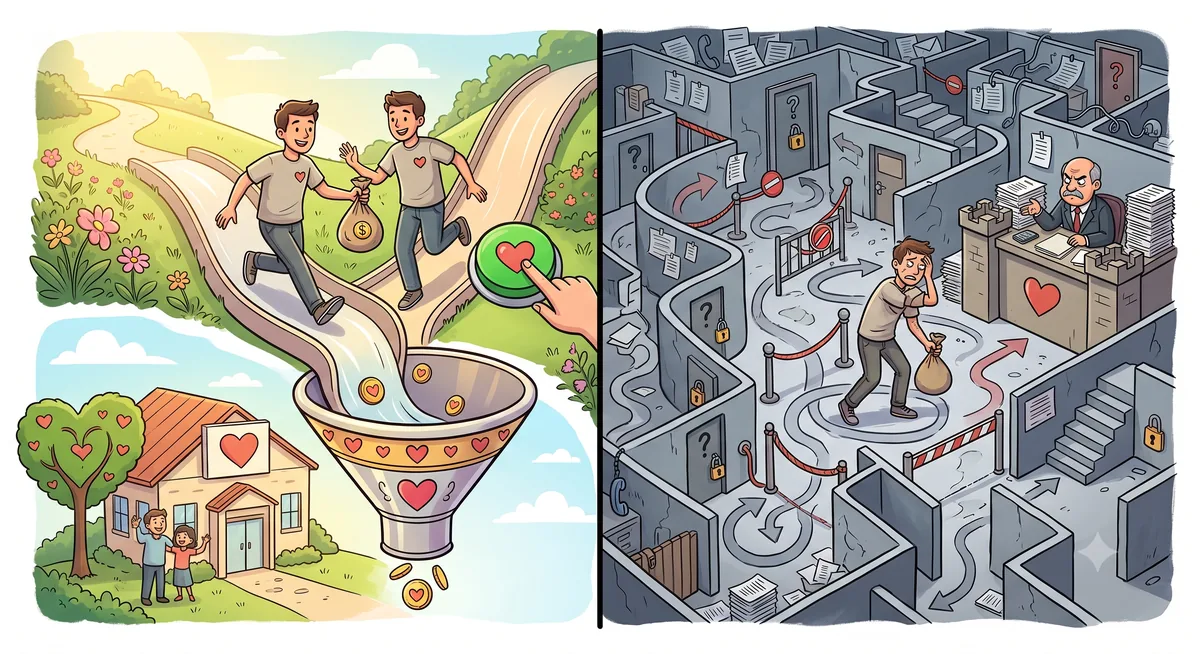
Because cancelling is not organised the way signing up is. Research by the Dutch donor association Stichting Donateursbelangen found that with more than 60% of the charities studied, it is hard to find out how to stop at all. Below is what to do: to end your donation, and to stay free of it afterwards.
Cancel in writing, and make sure you can prove it
Some good news first: once your cancellation reaches them, it is usually processed without any fuss. The hard part is the step before that — finding the right address and the right route.
So do it in writing. An email is enough, a letter works too. Keep the confirmation, and if you use the charity's own web form, check afterwards that a confirmation actually lands in your inbox.
Not because you distrust anyone, but because it saves trouble: with a confirmation in hand you never have to argue about whether or when you cancelled. Cancelling by phone is quicker, but it leaves you empty-handed.
What to include in your cancellation
A charity can only process your cancellation if it knows who you are and which account the money is being taken from. So give your full name, address and city, your email address for the confirmation, and the last five digits of the account being debited. If you have a donor number, add it.
State explicitly that you are also withdrawing your direct debit mandate. Cancelling and withdrawing the mandate are two different things.
And if money is still taken afterwards? Open the payment in your banking app and have it returned. You can do that up to 56 days after the debit, without giving a reason and without consequences. A donation carries no payment obligation: you owe the charity nothing.
Ask them to delete your data
Stopping your donation is one thing. Disappearing from their files is another. Without a deletion request you simply stay where you were, and a week after cancelling there is post on the mat again, or the phone rings during dinner.
So copy this sentence into your message to the charity:
I also request, in accordance with Article 17 GDPR, the immediate deletion of all my personal data within the meaning of Article 4(1) GDPR, save in the cases listed in Article 17(3) GDPR.
The wording is formal, and that is no bad thing: it makes it immediately clear to whoever processes it what you are asking for, and nobody has to guess what you meant.
Why is cancelling made so difficult?
Start with this: a new donor costs money. When a charity recruits on the street or at your door, there is a fundraising agency behind it that earns a commission for every donor signed up. That commission is substantial, and it is recovered from your first twelve to sometimes twenty-four monthly payments. In other words: in that first year your donation goes towards the cost of finding you. What you give after that goes to the cause itself.
A donor who stops after eight months is therefore a loss for the charity. That does not make them villains — they do good work, and nobody is holding up your cancellation — but it does explain why the cancellation details are rarely on the homepage, and why you are more likely to be offered a lower monthly amount than a form to stop. The sector has agreed, through its own supervisory body, that cancelling should be as easy as signing up. There is still work to do.
The most cancelled charities at a glance
Many of our visitors want to cancel several charities at once. That means a lot of searching. We have made it easy for you with direct links to the most cancelled charities:
Cancel Oxfam Novib
Cancel Unicef
Cancel Doctors Without Borders
Cancel KWF Kankerbestrijding
Cancel Hartstichting
Cancel KIKA
Cancel CliniClowns
Cancel Greenpeace
Cancel Amnesty International
Cancel Save the Children
Cancel Aidsfonds
Cancel Cordaid
Cancel Wilde Ganzen
Cancel Natuurmonumenten
Is there a notice period for a donation?
For an ordinary donation there is no statutory notice period: you can stop at any moment.
Can I simply stop my donation through my bank?
You can have a direct debit reversed up to 56 days after it was taken, and block the mandate at your bank. That frees you from the charity. But it is nicer to cancel properly with the charity itself. They generally process cancellations quickly, and then you are done with it too.
If you have an amount returned, there is no payment obligation afterwards. You owe the charity nothing.
How long may a charity keep my data after I cancel?
Only for as long as there is a legal basis for it. Would you rather not rely on that? Then explicitly request deletion under Article 17 GDPR. This is a standard part of our cancellation form. Tip: cancelling directly with the charity yourself? Then simply copy the paragraph from our template into your message.
Do I have to give a reason for stopping my donation?
No. You do not have to give a reason, and you do not have to accept an offer to lower your amount or pause it for a while.